PNW Beach Kit: A Multi-Prototype System for Cleaner Beaches
Team Member • HCDE 351 UX Prototyping
PNW Beach Kit is a system designed to help regular beachgoers clean up their local Pacific Northwest beaches in an accessible and engaging way. Using five different prototyping methods, each tied to a specific evaluation goal, we explored modular tools, reusable bags, a storage station, and informational signage to lower the barrier to beach cleanup.
Project Overview
Team Member
Rapid prototyping, usability testing, environmental design
April - June 2026 (10 weeks)
Cardboard, 3D printing, laser cutting, sewing, Figma
The project was inspired by the UN Sustainable Development Goal 14: Life Below Water, which targets keeping our oceans clean by cleaning and reducing waste. We narrowed that goal to something tailored to our location and class project: cleaning Pacific Northwest beaches, which are often rockier, wetter, and harder to access than standard “golden sand” beaches.
PNW Beach Kit is a stand placed at the entrance to these beaches. It holds modular tools, reusable trash bags, informational signage, and a storage station, making it a ready-to-use, free option for cleaning beaches. Our goal was to encourage beach cleaning behavior by reducing the barrier to participation.
Prototyping Goals
Each prototype was built with a specific evaluation goal in mind. Throughout the process, we took team and user feedback, folded it into our designs, and tested again to build a deeper understanding of the overall product.
- Cardboard (tool heads): Quickly explore tool shapes, sizes, and attachment concepts, and test whether users understand each tool's purpose and can use it to clear debris.
- 3D printing (modular tools): Shift from understanding to usability. Can users clean debris easily, and can they build and break down their own tools? We also wanted to learn how usable typical beach cleaning tools are, and where ours might work better.
- Laser cutting (storage station): Test organization, accessibility, and feasibility for public beach use, and see whether users would approach and interact with the station.
- Sewing (reusable bags): Test durability, and whether users would choose a handheld bag over returning to a trash can.
- Figma (informational signage): See which sections users actively look for, and whether the information is clear enough to make the kit intuitive.
Early Sketches
Early sketches helped us picture how the tools, storage station, bags, and signage would work together as one complete system, from a sign at the beach entrance to the tools, bags, and storage laid out at the stand.
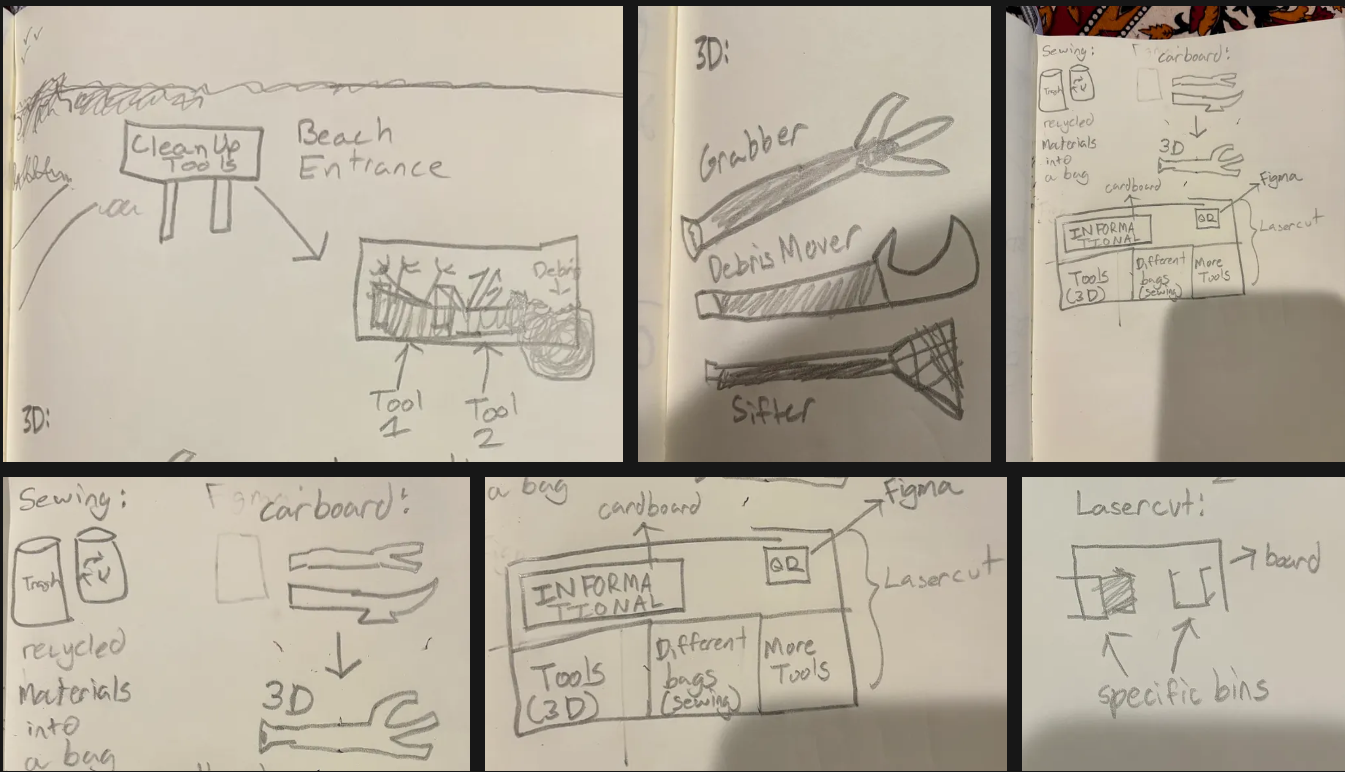 Early sketches of Beach Kit: the stand at the beach entrance, 3D tool concepts (grabber, debris mover, sifter), the stand layout with each fabrication method labeled, and laser cut bins.
Implementation
Cardboard: Low Fidelity
We all worked on the first round of prototypes, quickly iterating on different tool heads to visualize what each would look like and describe what it would do. We focused on PNW beaches and the tools suited to them, and created three cardboard tools: a rake to gather debris, a shovel with sand filters to scoop up trash, and a rollable filter to push across the sand. Low fidelity let us come up with ideas fast without getting stuck on attachments and materials. Cardboard prototyping was especially valuable because it let us iterate rapidly before moving into more time-intensive fabrication.
3D Printing: Mid Fidelity
We then redesigned the tool heads to be 3D printed, using measurements similar to the cardboard versions and adding wheels and mesh filters. We designed modular handles so every tool head attaches to the same handle, plus extension pieces that change the length of each tool. The result was three unique 3D printed tools with modular handles. We chose mid fidelity because we wanted to test usability and function rather than final materials or appearance.
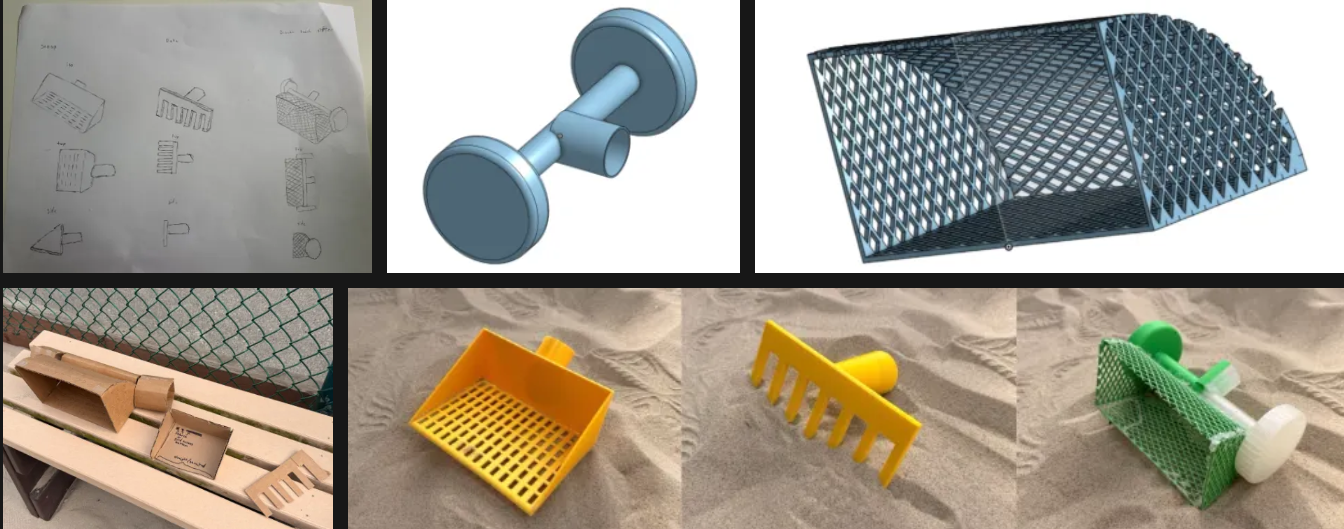 Tools at different stages: tool head sketches, CAD models, cardboard prototypes, and the final 3D printed scoop, rake, and rolling filter tested on sand.
Laser Cutting: Low Fidelity
For the storage station, we designed a small version of what would be a permanent storage area on the beach: a wooden box with four compartments created by removable dividers. We chose wood over cardboard for durability, and kept fidelity low to focus on organization rather than the logistics of keeping a storage system outdoors. A mid or high fidelity version would likely use more durable materials that require more setup than laser cutting alone.
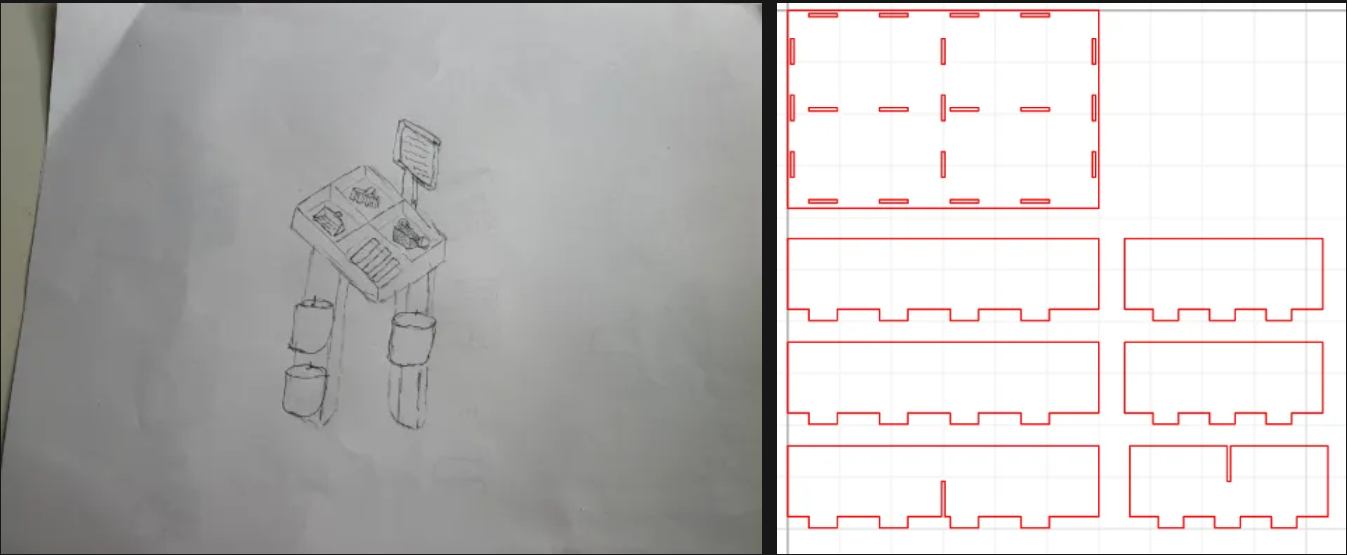 A more detailed stand sketch (left) with storage on top, hanging bags, and a sign, alongside the laser cut file for the storage box (right).
Sewing: Mid Fidelity
We originally planned one large trash bag to leave at the stand, but switched to smaller bags users could carry with them while cleaning, so they wouldn't need to haul trash back to a set location. We cut a plastic tarp into different sizes and shapes. The material was light, durable, airtight, mostly resistant to liquids, and recycled, which fit our UN goal. Users would take a bag from the stand, fill it while cleaning, and return it to be properly disposed of.
Figma: Mid Fidelity
We made mock-up signs organized into three sections: the problem (why the kit is on the beach), the solution (an overview of the kit), and use (how to set up tools and collect trash). Across four iterations the signs carried the same information displayed differently. Ideally, the signs would sit above the storage area as a central place to learn what the PNW Beach Kit does. We kept the content relevant but not fully specific, while making the visuals close to final so we could learn what information users wanted to see.
Evaluation
We tested each prototype against the goal we set for it:
- Cardboard: We asked users whether each tool's purpose was clear and whether the shapes looked effective for collecting beach debris.
- 3D printed: We asked whether the handles were comfortable, whether the modular system was easy to assemble and disassemble, and whether the tools cleaned debris effectively. We also tested durability of the PLA parts. Several users found some pieces fragile under stronger force, suggesting future versions need stronger materials or reinforced structures for outdoor use.
- Laser cut storage: We asked whether the layout was easy to understand, the compartments clearly organized, and whether users would feel encouraged to use the station at a real beach.
- Sewn bags: We asked whether the bags felt durable enough to carry debris and whether they were more convenient than repeatedly returning to a trash can.
- Figma signage: We asked whether the information was easy to understand, which sections drew the most attention, and whether the sign raised awareness of beach pollution and cleanup.
Overall, users responded positively to the accessibility and environmental purpose of the system, but testing revealed areas for improvement in tool ergonomics, attachment clarity, and material durability.
Analysis
What Worked
- The idea felt novel and engaging. Many users said they wouldn't want to bring their own bags and tools to a beach, so having them on site was an ideal solution.
- The modular tool system gave users room to build the tools they wanted rather than being boxed into set categories. Having tools readily available and customizable is something that could carry over to other cleaning systems.
- Handheld bags supported the kit's flexible cleaning goal by freeing users from immovable trash cans.
- A large sign created a central place to find information and made the kit look more professional.
What Needed Work
- Storage: Four compartments weren't enough for all our components. One large space or more than six compartments would work better.
- Tool clarity: The tools were less intuitive than we expected. Even with the sign, users needed a visual demonstration. Adding pictures to the sign or information on the tools would help.
- Tool usability: Many users struggled with the handle attachments, and adjusting their angle would have helped.
What We'd Do Differently
Knowing what we know now, we would focus more on the informational side of the stand, building a fully physical poster instead of the storage box or trash bags, which were already clear to understand and easier to implement. Many users also assumed kids or a different audience than we intended would use the kit, so a future version would be more educational and target a younger audience.
Outcome & Reflection
Cardboard prototyping proved extremely valuable. It let us test multiple tool concepts quickly before committing to higher fidelity fabrication, and surfaced usability issues early. The modular tools and organized storage also helped make beach cleanup feel more approachable and structured.
Testing also showed that some attachments weren't understandable without explanation and some storage compartments needed easier access. In future iterations we would improve labeling, refine attachment ergonomics, and test durability in real beach conditions.
Overall, this project showed how combining prototyping methods at different fidelity levels can help evaluate usability, feasibility, desirability, and impact within a complex physical interaction system.
Tools & Skills
- Rapid prototyping across multiple fidelities and materials
- 3D modeling and printing, laser cutting, and sewing
- Figma for informational design
- Usability testing and user feedback synthesis
- Designing for sustainability (UN SDG 14)